

ZOOM IN WITH SOUKAINA YEOJA
An artist turning textile into social commentary
Soukaina is a textile and visual artist from Casablanca whose practice brings together fiber and textile arts, photography, mixed media, video editing, and writing.
Through Yeoja, she uses handmade forms to explore femininity, identity, the body, mental health, social tensions, and the contradictions of contemporary life. Her work often appears playful at first, yet carries direct messages shaped by humour, cultural references, and personal reflection.
In this Zoom In, Soukaina reflects on handwork as a ritual, textile art as a non-verbal language, Darija as a source of grounding, and the growing importance of intentional making in an increasingly accelerated world.
A Practice Shaped by Observation and Doubt
Soukaina works across crochet, knitting, sewing, photography, mixed media, video editing, and writing. Through these different mediums, she explores the questions that emerge when she places herself in a position of observation, reflection, introspection, and doubt.
Yeoja exists as an extension of this wider artistic practice. It began with a major question surrounding her femininity and a desire to explore the subject by following the traces of women within her family and ancestry.
Many of these women used crafts both as a means of self-expression and as a way of making a living. Through Yeoja, Soukaina continues to examine that relationship between femininity, handwork, identity, and inherited knowledge.
Making by Hand as a Ritual
Making things by hand feels natural to Soukaina, almost as though she is responding to her hands’ calling to use their motor skills creatively.
She regards handwork as a ritual, a practice of patience, and an open contemplation of movement and the symbolism of repetition.
The process engages all her senses and her mind. Because the experience feels tangible and real, it also helps her feel more present within reality.
Fiber as a Non-Verbal Language
Crochet and knitting have been part of Soukaina’s life since she learned them in middle school. Alongside writing and drawing, they became essential parts of how she occupied her free time.
It was only after starting Yeoja and developing it into her full-time practice that she was able to explore textile arts more deeply.
Through continued learning and experimentation, she fell in love once again with their immense potential and possibilities as a non-verbal language.
Using Slow Craft to Address Urgent Subjects
For Soukaina, textile art offers a slower and more intimate way of speaking about urgent subjects.
The practice is both time-consuming and physically demanding. It takes time to learn a technique, construct a balaclava or conceptual installation, and understand how an idea can be translated into fabric and form.
It also requires patience to sit down and repeat stitches, especially when the finish line remains weeks or months away. The process demands perseverance when the wrists, neck, and shoulders begin to hurt.
Most importantly, textile art requires presence. The moment the maker becomes distracted or lost in thought, it can immediately appear in the tension or regularity of the stitches.
These constraints give each gesture weight, meaning, intention, and love. For Soukaina, this is what makes textile art such a beautiful and profound medium through which to address urgent topics.
The stretching of time imposed by the slow process also allows her to approach difficult subjects in a calmer, more poised, and reflective manner, rather than responding through the immediate and reactive rhythm often encouraged by social media
Playfulness as a Way Through Heaviness
Many of Soukaina’s works appear playful at first, before revealing direct, political, or emotionally complex messages.
This contrast is important to her because playfulness breaks through what she describes as the rigid barrier and tall, brutalist fortress of seriousness.
Although she approaches her work seriously, she finds it difficult to engage with heavy topics without introducing humour. Playfulness helps her digest the emotional weight of the themes she explores.
Her practice addresses identity troubles, femininity, and the body as both a vessel and a kind of fate, where no wound goes unwritten. It also engages with self-harm, depression, love, heartbreak, capitalism, consumerism, and hypocrisy within society.
Without some element of play, she believes the heaviness would become overwhelming.
Even when a message appears direct, Soukaina leaves considerable space for the viewer’s interpretation. Meaning can also be found through the symbols and non-verbal details embedded within each piece.
When the Object Carries the Message
The relationship between the object and the message changes according to each idea.
Sometimes the object comes first. At other times, the message leads the creation. In certain works, both emerge simultaneously.
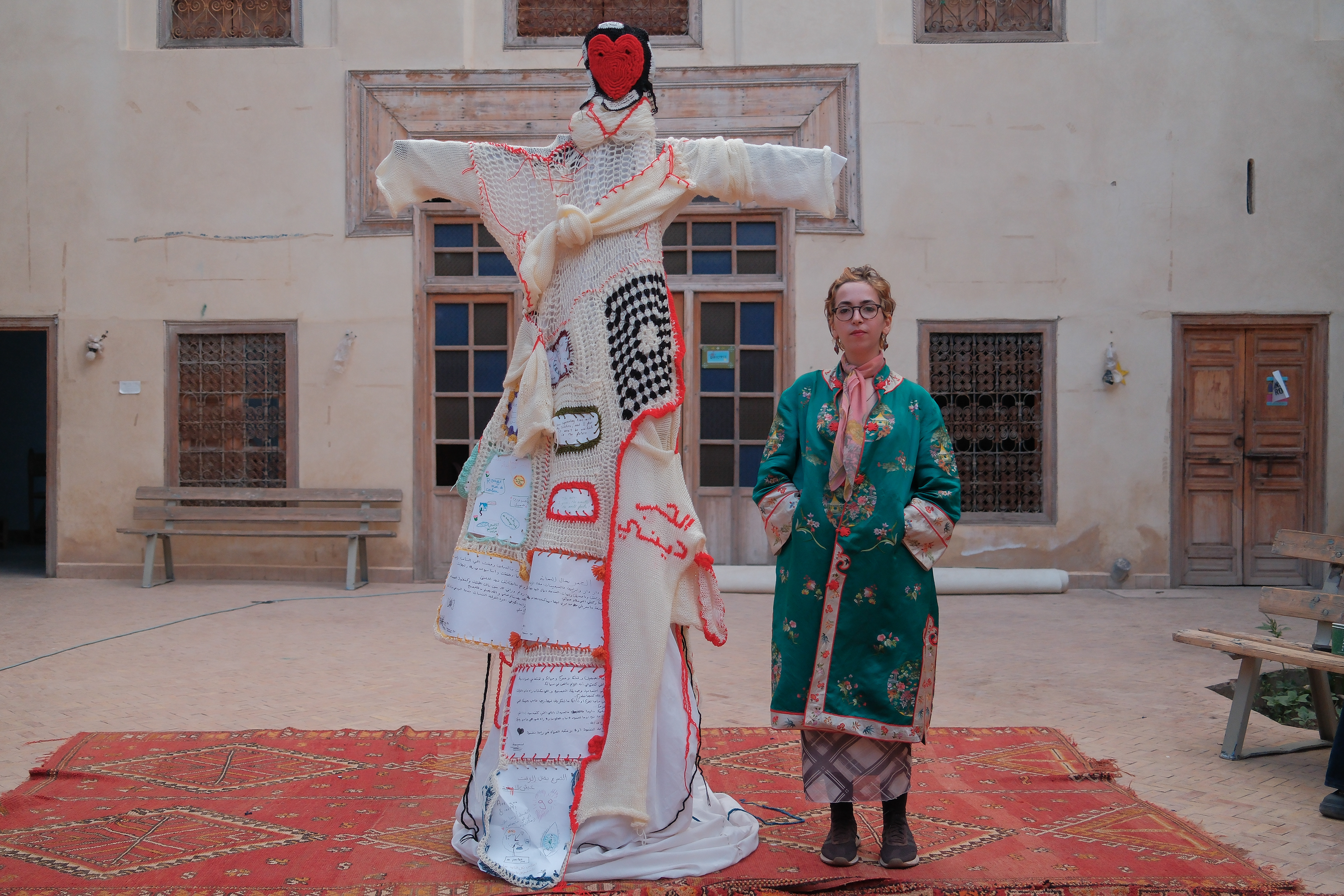
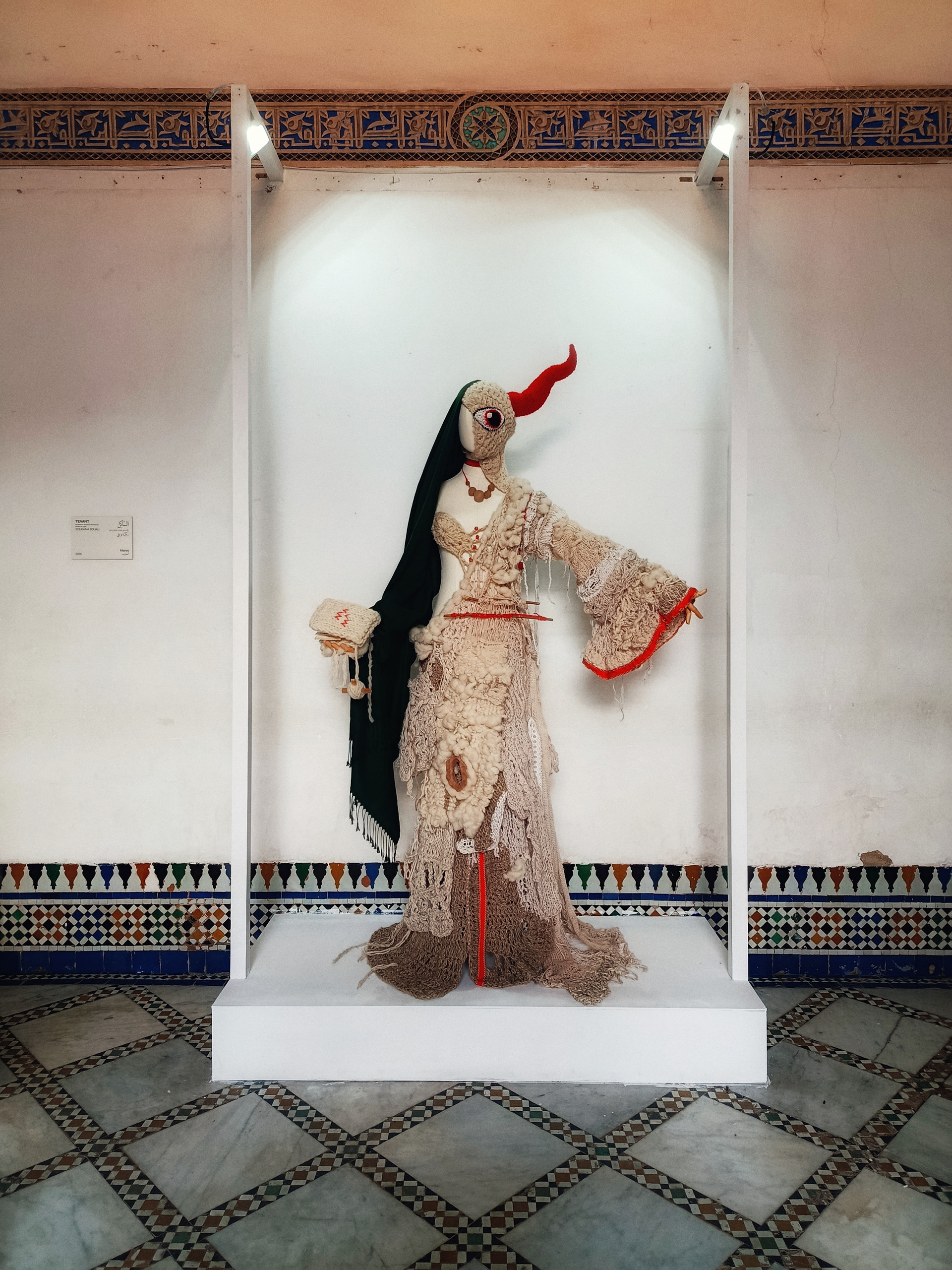
With Tofita Man, the form itself carried the message. The three eyes, the large eye emerging from the stomach, the detailed fingertips, and the other physical elements became part of the work’s language.
With the Castrate the Predators tapestry, however, the message came first and remained the central priority throughout the process.
For Soukaina, there is no fixed formula. The starting point depends entirely on the idea and what it requires.
Darija as an Antidote
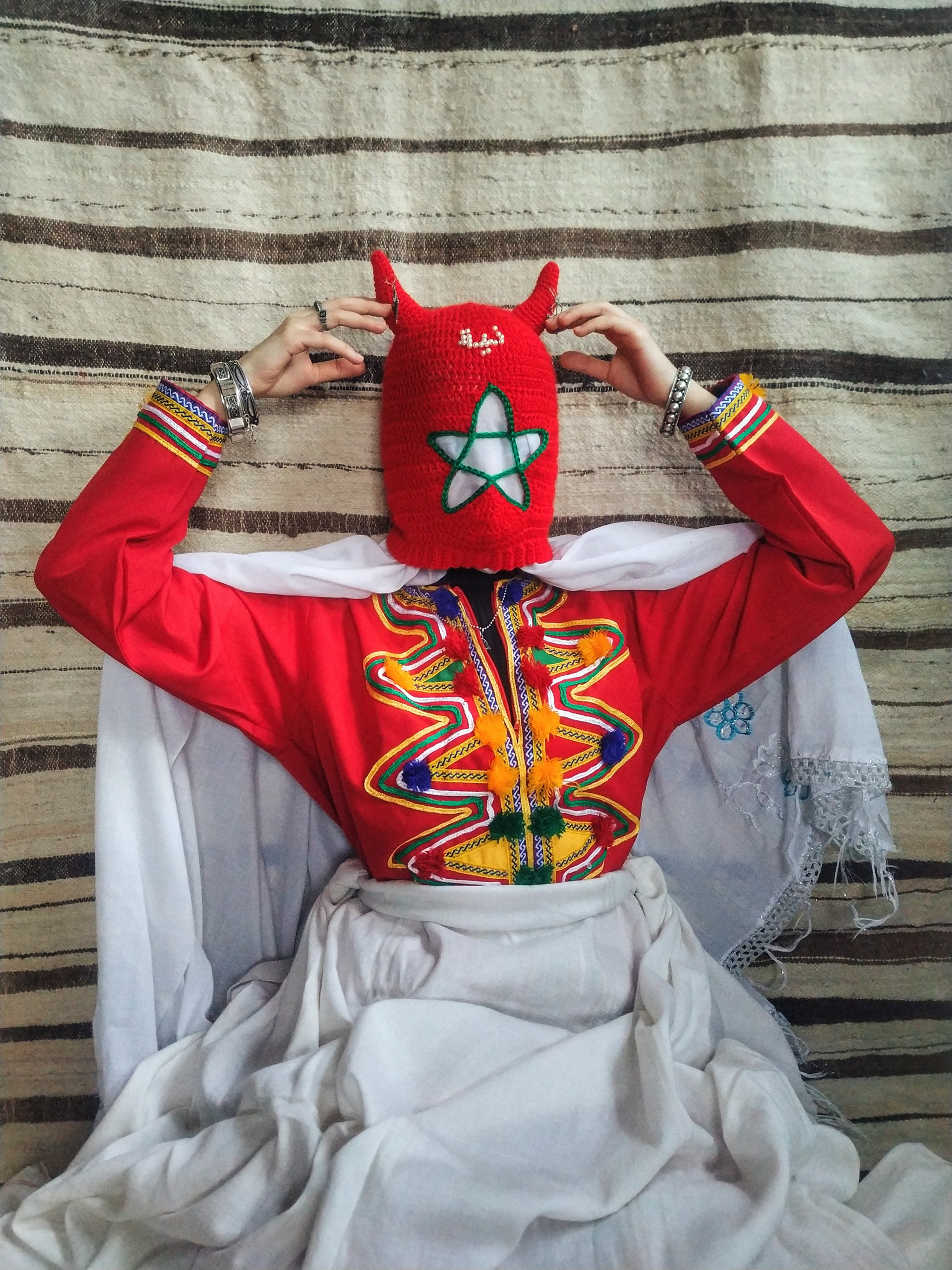
Soukaina describes Darija as an antidote.
This may appear contradictory because she primarily uses English in her work and online communication. However, this choice comes mainly from practicality and from having spoken English as a second language for more than 20 years.
Despite this, she regards Darija as a deeply profound language, carrying the wisdom and rich scope of expression found in Fusha Arabic.
She curses in Darija when her yarn becomes tangled, and finds something satisfying in that instinctive response. When she stitches Darija into her work, the words can feel like a good-luck charm or like a manifesting and protective object.
Maintaining a connection with Darija and everyday Moroccan life allows her to be more nuanced in her expression and more respectful of the ideas and meanings she wants to communicate.
It also keeps her grounded in her identity as a Moroccan, something she considers essential to her psychological and emotional well-being.
Handmade Work in an Accelerated World
Through her work, Soukaina hopes people will see textile arts and crafts as an infinite realm of possibilities.
She hopes viewers will feel inspired to experiment, play, and express themselves through what she describes as an annoyingly anti-capitalist, slow way of creating.
She also hopes they will fall in love, or rekindle their love, with Darija, colours, and art.
As technology continues to reshape the way the world operates, Soukaina believes handmade work, crafts, intentional making, and art will become much, much, much more necessary.
This need will grow as society sinks further into a world seduced by modernity’s hyper-normalisation and the increasing accessibility of everything.
For her, this evolution is also connected to the growing distance between contemporary life and the ways of previous generations, resulting from changing relationships with nature, the earth, agriculture, and the organic use of public space.
Photo 1 @khaldraji
Photos Soukaina
Photos Soukaina