

ZOOM IN WITH NOUREDDINE ZOUAGUI
A multidisciplinary designer reimagining Moroccan cultural references
Noureddine Zouagui's creative practice has moved across styling, fashion design, art direction and visual culture, but a recurring method connects much of his work: taking recognisable Moroccan references and placing them in contexts where they are not usually expected.
From T-shirts drawing on Moroccan Kingdom stamps and a leather jacket incorporating real zellige to hybrid garments, music-video worlds and eventually the TAWS watch, his work has repeatedly explored how cultural references can be transformed while retaining their identity.
For this Zoom In, Zouagui traces that practice from Casablanca's second-hand markets and early urban culture to the development of TAWS, revealing how an idea becomes an object and how an object can expand into an entire visual world.
Finding a creative language through styling
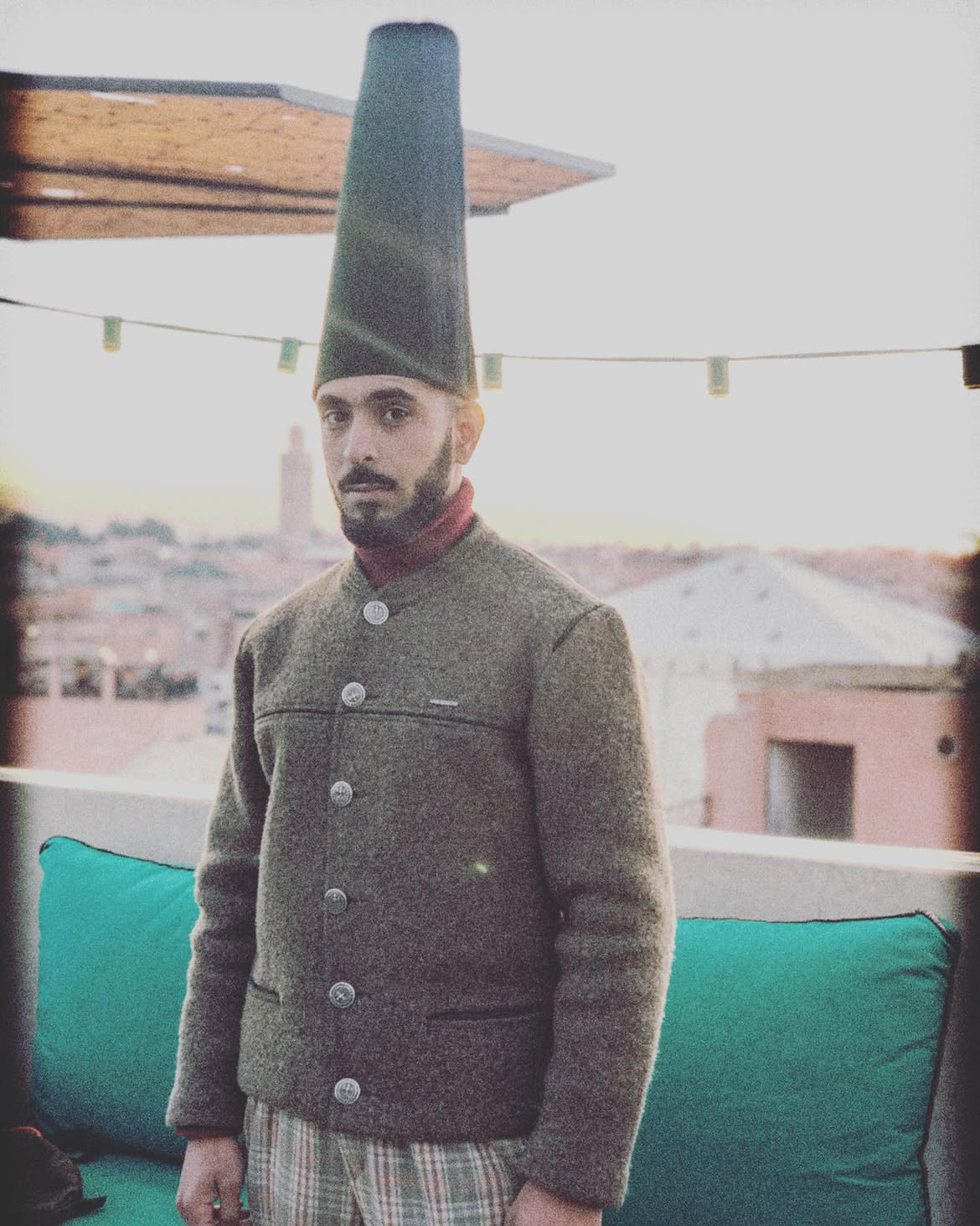
Noureddine Zouagui is 33 years old and was born in Casablanca. His route into styling happened somewhat accidentally.
Around 2004, access to international fashion brands in Morocco was still very limited. Rather than waiting for someone to bring him the clothes he wanted, he began designing and creating his own pieces. He would also search for second-hand clothing at Derb Mila and other markets around Casablanca, then reinterpret what he found in his own way.
At the same time, Zouagui was part of what he remembers as a relatively small urban culture community in Morocco. This was before social media had reshaped how creative communities connected. People knew one another and shared references across music and culture. Gradually, he began to recognise that what he was doing was distinctive enough for him to bring his own perspective to it.
The transition towards styling began through friends who were rappers. Zouagui would lend them clothes he had designed or discovered, which would then appear in music videos and performances. What began as a personal passion gradually revealed a possible professional direction.
Hip-hop, pop culture, MTV, music videos and the wider visual culture surrounding them became important early influences. He was less interested in dressing according to what was considered normal than in finding pieces that reflected his influences and allowed him to feel different.
That experimentation eventually developed into styling and later creative direction, allowing fashion to become a way of expressing the references and cultures that shaped him while developing something personal and distinctive.
Taking the Taouss tray somewhere unexpected
The starting point for TAWS was a desire to think outside the box.
Having lived in Europe for some time, Zouagui describes maintaining a strong connection to Morocco alongside a sense of missing home. He wanted to express where Moroccans come from without returning to the familiar ways Moroccan culture is often represented. Instead, he was searching for a contemporary and unconventional language that could still communicate that connection.
The idea of transforming the traditional Taouss tray into a watch first appeared in 2022. He held onto the concept until 2024, when he decided to develop it further.
TAWS, however, did not emerge in isolation. It continued an approach visible throughout his previous projects.
In 2016, Zouagui created T-shirts inspired by Moroccan Kingdom stamps. Two years later came “Marrakech,” a leather jacket incorporating real Moroccan zellige directly into the garment. Developing the jacket required collaboration between a jeweller, a zellige artisan and a tailor, bringing several forms of craftsmanship together within one piece.
Around 2022 and 2023, he explored another intersection, this time between Moroccan fashion and football. A djellaba was constructed from second-hand football jerseys from teams around the world. He later developed “Mdema,” a tie similarly informed by Moroccan cultural references.
Across these projects, the recurring principle has remained consistent: identifying something culturally familiar and repositioning it somewhere unexpected without removing the identity and meaning that made it recognisable in the first place.
TAWS continues that process by taking one of those particularly familiar objects, the traditional Taouss tray, and transforming it into something entirely different: a watch.
From a vintage watch experiment to TAWS
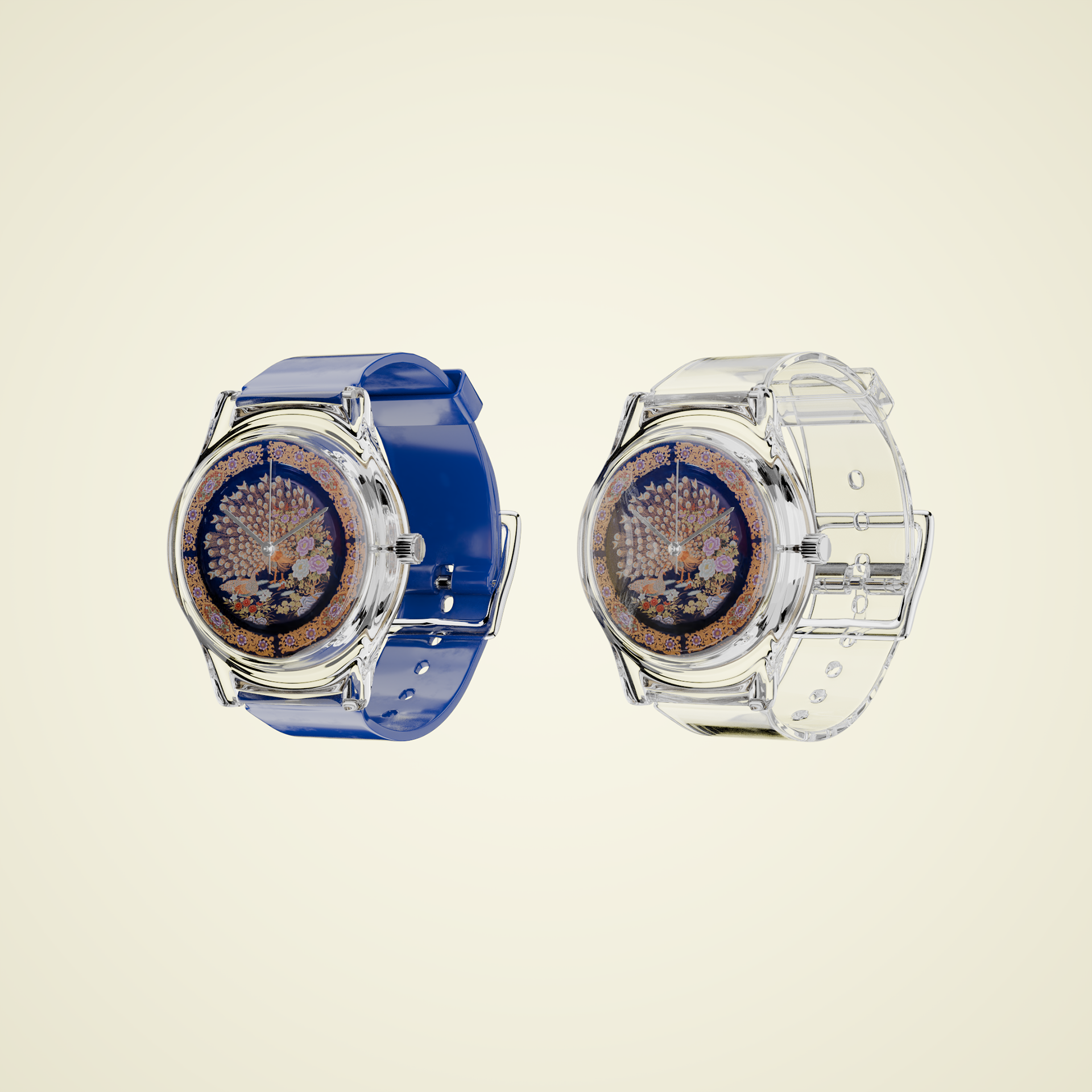
The first version of the TAWS idea was relatively direct. Zouagui imagined printing the traditional Taouss tray design and applying it to a vintage watch. Seeing that combination was the point at which the concept began to make sense to him.
The next challenge was finding people capable of translating the idea into a physical object. An initial prototype was eventually produced with a Swiss watchmaking artisan. Seeing the concept physically materialise gave Zouagui greater confidence to continue developing it.
A subsequent prototype with the factory allowed the team to explore and refine the design more seriously.
One of the most significant changes concerned the Taouss design itself. An initially simpler interpretation developed into a much more intricate and detailed version of the tray. The additional detail strengthened the identity of the watch and made its relationship with the original object considerably more visible.
The thinking also expanded beyond the watch.
Its packaging contains two straps, one blue and one transparent, allowing the wearer to change the character of the piece. The back incorporates an image of the display cabinet in which Taouss trays are traditionally presented in Moroccan homes.
For Zouagui, this detail refers to a familiar domestic image. In many Moroccan households, the trays sit behind the glass of a living-room cabinet, displayed almost as artworks might be presented inside a museum.
A written story about the Taouss tray was also incorporated into the back of the packaging, explaining the object, its place within Moroccan homes and the cultural context from which the watch emerged. The intention was for the packaging to do more than contain a product. It needed to participate in telling its story.
The final TAWS watch therefore emerged through multiple iterations between the original concept, physical prototypes, watchmaking and the cultural details surrounding its source material. The objective was to produce a genuine reinterpretation of the Taouss tray rather than simply placing a Moroccan pattern onto a watch.
Building a visual world around the object
The visual campaign began through a conversation between Zouagui and EyesofNasser, whose work he had already admired. Zouagui presented the product, Nasser immediately connected with the idea, and the two began developing its visual direction together.
Their first output was a pair of teasers.
The first placed a real peacock inside a Moroccan salon. Producing the scene required considerable time, particularly to position the peacock within the intended spotlight and create the atmosphere they had imagined.
The second teaser took a very different route by showing a Taouss tray being broken. Zouagui describes the image as a genuine shock for a Moroccan viewer. Together, the two teasers were intended to generate curiosity while introducing the cultural references surrounding the product.
The official campaign video then developed around a split-screen concept. An older brother and younger sister appear in parallel scenes. He interacts with vinyl, while she interacts with the Taouss tray. Match cuts and shot-reverse-shots allow the two worlds to mirror one another before gradually connecting.
An important creative decision was to withhold the product itself.
Instead of immediately placing the watch at the centre of the campaign, the team first established its story, atmosphere and sense of curiosity. TAWS appears only towards the end, allowing the product reveal to function as the conclusion of the narrative rather than conventional product placement.
The collaborative team expanded as the concept developed. Drawing on both Zouagui's and Nasser's experience, they brought in creatives they believed could take the project towards the level they envisioned.
Music was approached as another component of the same world. A listening session took place at Nasser's vinyl store, where they explored different records and considered what might fit the campaign's visual universe. Khazzi later joined the process, bringing his own contribution to the final sound.
The campaign ultimately brought together performance, direction, editing, 3D, music, curation, voice and digital management. It starred @zif7ayati and @Yacinee.ou, was directed, edited and coloured by @Bnitri.off, included 3D by @abdellatifhouza, music production by @khazziii, curation by @Records_Zaman, voice-over by @Tcheirloom and digital management by @lconsigliere.
By bringing these practices together, Zouagui felt the project acquired a dimension beyond the original idea. His work in design and product, Nasser's art direction and the contributions of the wider team expanded the project while maintaining the identity and meaning of TAWS at its centre.
A practice shaped through fashion, music and Moroccan references
Long before TAWS, Zouagui's work was already concerned with translating Moroccan references through fashion, styling and visual culture.
His Moroccan stamp T-shirts were an early example. The pieces appeared in Shayfeen's “Wach Kayn Maydar” music video, worn by artists including Don Bigg, Dizzy DROS and 7liwa. For Zouagui, it represented an important moment because a familiar Moroccan reference was entering the urban music scene through an entirely different visual context.
The “Marrakech” leather jacket, incorporating real Moroccan zellige, later appeared in Snor's “La La La” video. Zouagui also worked on the overall styling and created the cagoule used for the project.
His collaborations with Inkonnu allowed that approach to expand further. “Mama” became particularly important because Zouagui developed its fashion universe around a Moroccan futuristic aesthetic. “Arab Tech” served as a central piece within that world, imagining futurism while remaining rooted in Moroccan identity.
For “Genkidama,” he moved across both art direction and fashion design, developing the video's wider visual and fashion universe.
“Tarbob” brought another pair of references together. The piece combines the bucket hat, closely associated with hip-hop culture, with the traditional Moroccan tarbouche. The hybrid allowed Zouagui to connect two objects carrying very different cultural associations.
“Mdema” later appeared in “Yalla Bina,” Inkonnu and Saad Lamjarred's music video for the CAF.
Music videos have occupied a significant part of Zouagui's career, with his role moving between designer, art director and sometimes both. His projects include design work for Manal and Inkonnu's “Warda,” as well as work with Stormy on Draganov and Ou T T, Toto on Thezz, Small X on Price, Madd on Karma, Shayfeen on Koun Wajed and Blessed, and Krtas Nssa on Superbtch. He also worked as a stylist on Small X feat. Dosseh's “Kssiri.”
These projects allowed fashion, art direction and visual storytelling to develop simultaneously within his practice. Music videos became an experimental space where clothing, Moroccan references, contemporary culture and different visual languages could intersect.
The same method eventually led to TAWS. Whether working with a traditional object, garment or cultural symbol, Zouagui's interest remains in taking something recognisable and changing its context without removing the identity that made it meaningful in the first place.
Creative Team :
Watch designed by : @zouagui_noureddine & @fazou_ramdi
Creative direction : @Eyesofnasser & @zouagui_noureddine
Digital Manager : @lconsigliere
Starring : @zif7ayati & @Yacinee.ou
Directed, Edited & Colored by : @Bnitri.off
3D : @abdellatifhouza
Music Producer : @khazziii Curated by : @Records_Zaman
Voice Over : @Tcheirloom
Watch designed by : @zouagui_noureddine & @fazou_ramdi
Creative direction : @Eyesofnasser & @zouagui_noureddine
Digital Manager : @lconsigliere
Starring : @zif7ayati & @Yacinee.ou
Directed, Edited & Colored by : @Bnitri.off
3D : @abdellatifhouza
Music Producer : @khazziii Curated by : @Records_Zaman
Voice Over : @Tcheirloom