

Moga festival celebrates 10 years: how essaouira shaped a moroccan festival that went global
Born in Essaouira in 2016, MOGA has grown from an electronic music festival into a platform connecting artists, collectives, communities and destinations, while keeping its Moroccan roots at the centre of the experience.
Born in Essaouira in 2016, MOGA has grown from an electronic music festival into a platform connecting artists, collectives, communities and destinations, while keeping its Moroccan roots at the centre of the experience.
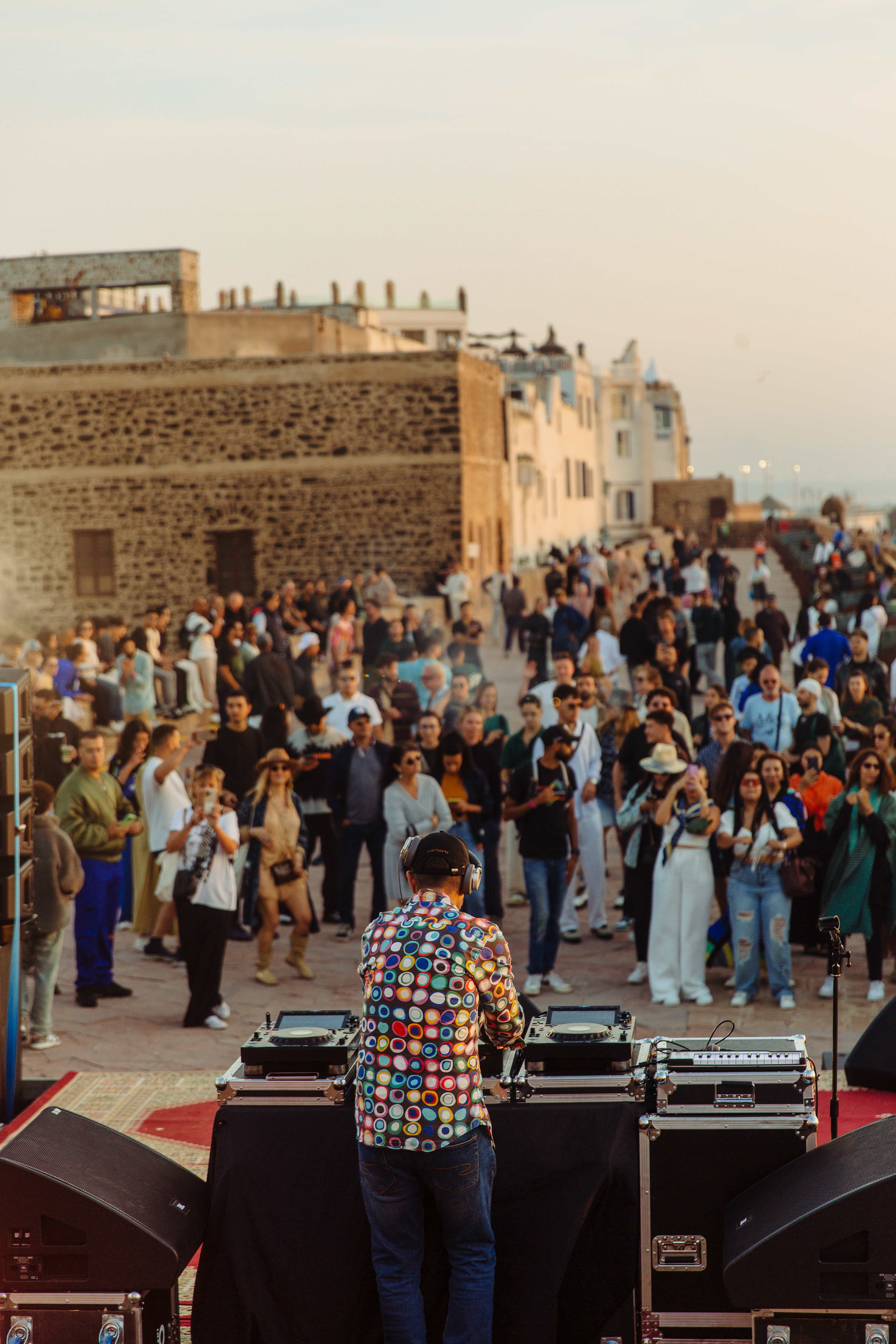
When MOGA was first imagined ten years ago, the festival was supposed to look very different.
The original plan was to stage it inside Essaouira’s historic ramparts, creating an experience shaped by the cinematic character of the fortified city. When that original concept was impossible with heritage protection, the team had to rethink the festival.
What initially appeared to be an obstacle became one of MOGA’s defining ideas.
Instead of concentrating the experience in a single location, the festival expanded into Essaouira itself. This approach eventually shaped the relationship between MOGA OFF, the programme spread throughout the city, and MOGA IN, the main festival experience.
Through MOGA OFF, cafés, cultural spaces and other local venues became part of the programme alongside concerts, DJ sets, surfing, yoga, workshops and other activities. Visitors were encouraged not simply to attend a festival, but to experience the city around it.
As the team puts it, “The city became the real headliner.”
Essaouira’s influence also extends beyond the festival format. Its relationship with the ocean, slower rhythm and history as a place of cultural exchange became part of MOGA’s identity.
That connection helped shape another early ambition: to contribute to the decentralisation of Morocco’s electronic music scene by creating a major gathering outside the cities where electronic events were already more established.
Supporting a Moroccan electronic music ecosystem
Over the past decade, MOGA’s relationship with Morocco’s electronic scene has developed on different levels.
Through MOGA OFF, Moroccan collectives are not only invited to participate. The festival says it increasingly provides support with production and access to venues, helping emerging collectives gain experience organising events at a larger scale.
MOGA IN creates a different form of visibility. Moroccan artists share a programme with established international names, giving audiences who may initially attend for a headliner the opportunity to discover artists they did not previously know.
For international visitors, this can also become a first encounter with Morocco’s electronic music scene, particularly for artists who may face barriers to performing regularly abroad.
That role has gained another dimension as MOGA itself has travelled.
From Essaouira to new destinations
After launching in Morocco in 2016, MOGA expanded to Portugal in 2021 and Spain in 2025. Yet the team has approached international expansion as more than reproducing the same festival somewhere else.
Elements first developed in Essaouira travel with it.
MOGA OFF encourages audiences in each destination to explore local cafés, restaurants, beaches and cultural spaces. Surfing, wellness and other activities remain part of an experience designed around the destination as much as the stages.
The festival’s visual identity follows a similar principle. Typography, colours and graphic elements adapt to each location while recurring references to the sun, moon, waves and natural landscape create continuity between editions.
A recent rebrand also introduced more references to Arabic typography and Moroccan visual culture. According to the team, those elements generated curiosity among audiences in Portugal, including festival-goers who subsequently expressed an interest in travelling to Morocco.
MOGA therefore increasingly sees itself as a Moroccan festival travelling internationally, rather than an international festival that happens to have originated in Morocco.
What it takes to survive ten years
A tenth anniversary also raises a less visible question: what does it actually take to keep a festival alive for a decade?
MOGA’s history includes the pandemic, the economic pressures facing the festival industry and the unpredictability that comes with producing outdoor events.
During a recent Portugal edition, severe storms caused coastal erosion that significantly changed the available festival site. Entrances, circulation routes, stages and other elements had to be redesigned before audiences arrived.
The goal, according to the team, is to be ready to open the doors to the Tribe on day one, with the experience living up to the promise from the very first moment.
That resilience has been supported by long-term relationships with partners and institutions, but the team points to another factor as central to MOGA’s continuity: its community.
People return not only for particular artists, but for what the festival calls the MOGA Tribe. Some travel between Moroccan and Portuguese editions, while others introduce new friends to the experience year after year.
MOGA’s festival-goers, the team says, are its best ambassadors, sharing the experience and bringing others into the community.
MOGA’s festival-goers, the team says, are its best ambassadors, sharing the experience and bringing others into the community.
From festival to platform
Ten years later, MOGA’s founders no longer see the project solely through the lens of a music festival.
“Looking back ten years, MOGA has transformed into a platform.”
That platform now brings together artists and collectives alongside people working across food, wellness, cinema, surfing and the arts. For the founders, the idea is closely connected to something they associate with Morocco and particularly Essaouira: hospitality, and the ability to create an environment where people feel comfortable gathering and expressing themselves.
What began in Essaouira is now travelling internationally, but the founders want that original identity to remain recognisable wherever MOGA goes.
Asked what they hope people will remember another ten years from now, their answer is not a particular artist, performance or stage.
“I hope they remember that they are part of something special, a Tribe that will have a home and a family wherever MOGA goes. No matter where they experienced MOGA in the world, they now carry a little piece of Morocco in their hearts.”
Perhaps that is the clearest way to understand MOGA’s first decade.
Born in Essaouira, shaped by its people, and now carrying a piece of Morocco wherever it goes.
Photo : Moga Festival