

Mina Abouzahra turns woven memory into a museum exhibition
In Woven Letters, the Dutch-Moroccan designer brings Taznakht weaving, family history and questions of authorship into her first solo museum exhibition at Museum Gouda.
In Woven Letters, the Dutch-Moroccan designer brings Taznakht weaving, family history and questions of authorship into her first solo museum exhibition at Museum Gouda.
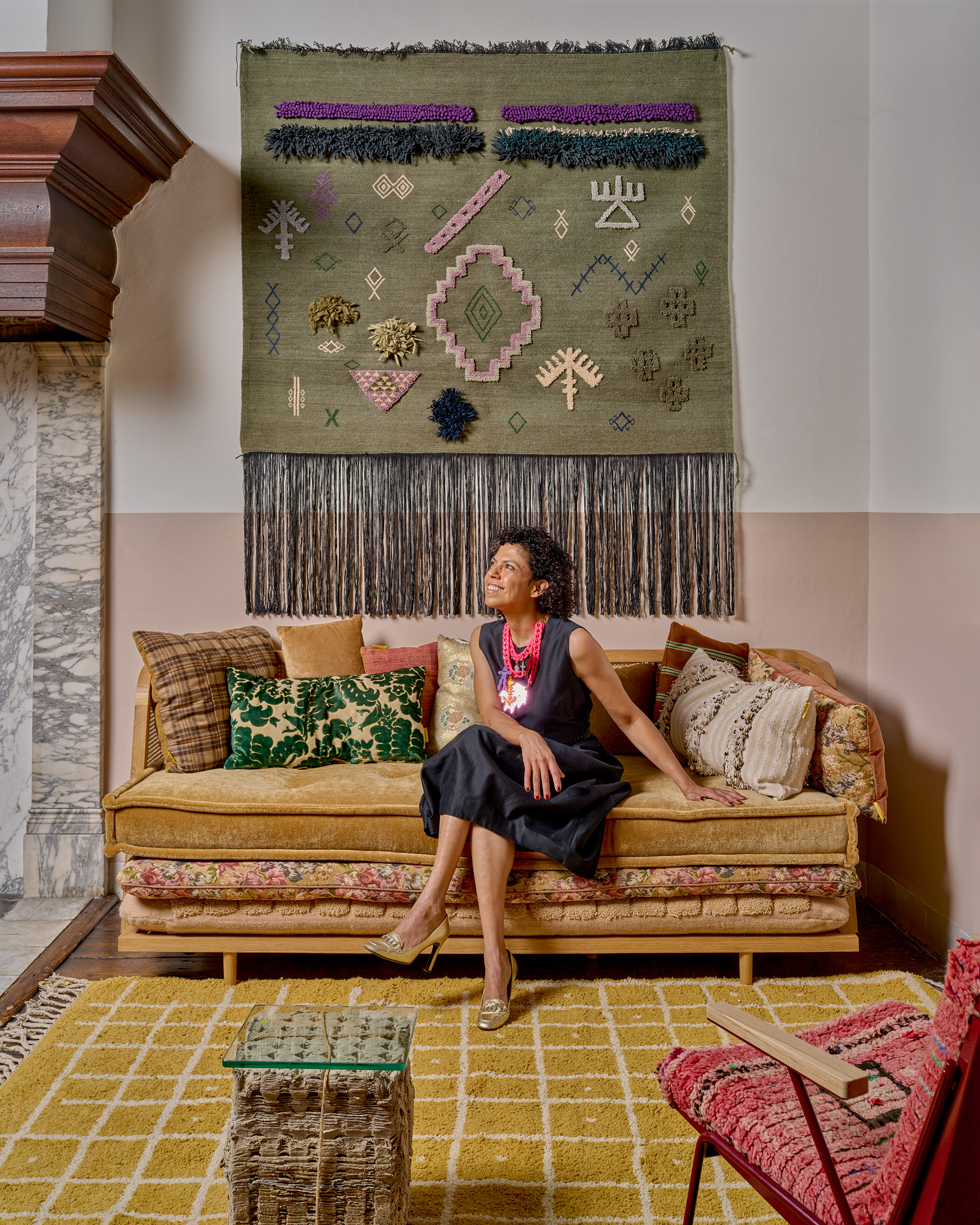
For Mina Abouzahra, a rug is never simply an object. It can hold a memory, record an experience or carry a message between people.
That idea sits at the centre of Woven Letters, the Dutch-Moroccan designer’s first solo museum exhibition, now on view at Museum Gouda in the Netherlands. Bringing together contemporary furniture, handwoven textiles from Taznakht and Amazigh symbols, the exhibition builds on more than a decade of Mina's practice between the Netherlands and Morocco.
“A rug is never just a rug,” she explains. “For female weavers across Morocco, it has always been a way to speak, a record of life, woven with symbols and colours that carry meaning across generations, with each region and community carrying its own language, rituals and tradition around the weaving and textile.”
One story in particular became central to the exhibition. Mina points to a tradition from Taznakht in which a newly married woman, after leaving her family to live with her husband’s, spends her first year weaving a rug. When her father visits, he takes the rug back to the family home, where her mother can read its colours and symbols as a way of understanding how her daughter is doing.
“It’s a woven letter between a daughter and the family she left behind,” Mina says.
That idea gives Woven Letters its name, but Mina’s relationship with weaving became more personal while she was spending time in Taznakht.
During a residency there, she decided to knot a rug herself. Through that process, she discovered something about her own family history that she had not previously known: both of her grandmothers had been weavers.
“I only truly understood this language when I knotted my own rug during my residency in Taznakht. This is when I discovered that both my grandmothers had been weavers. Suddenly it felt less like research and more like coming home. I understood this is my path.”
The discovery shifted the way she approached design. Rather than beginning primarily with form, Mina says she increasingly starts by asking what a piece needs to communicate. Within Woven Letters, works become carriers of messages, memories and references to Moroccan culture and customs. Her exploration of weaving has also extended to the Jacquard loom, allowing her to approach textile language through another process of precision and construction.
But looking at weaving as a language also raises another question for the designer: if a textile carries generations of knowledge, whose knowledge is actually being recognised when that textile enters contemporary design?
Mina works directly with a women’s cooperative in Taznakht and places the weavers’ contribution at the centre of how she describes that relationship.
“To me, reducing a rug to a commodity erases the person who made it. That’s why I work directly with the cooperative in Taznakht and insist on fair pay and shared authorship.”
Her own experience knotting a rug gave her a closer understanding of the time and labour involved in weaving. In her collaborations, she may arrive with a story or question, but the techniques, symbols and decisions involved in translating those ideas into textiles also draw on the knowledge of the weavers themselves.
“Authorship, for me, isn’t one name on a label. It’s making sure everyone whose hands and knowledge are in the work is seen, credited and fairly paid.”
That exchange between people and places extends beyond Taznakht in Woven Letters. For one project in the exhibition, Mina worked with eight communities in Gouda, asking participants to translate what mattered to them into symbols and colours. Those ideas were then transformed into contemporary cushions woven in Taznakht, creating another form of communication between the Dutch city and the Moroccan weaving community.
Elsewhere, the work Blessings draws inspiration from Kalaat M’Gouna in southern Morocco. Roses and date palms appear alongside Amazigh symbols found in rugs, bringing references to place, perseverance and blessing into a contemporary furniture piece.
Together, these works reflect the position from which Mina has been designing for years. Born in the Netherlands to Moroccan parents, she has developed a practice that moves between the Netherlands and Morocco, but Woven Letters does not treat those two contexts as separate worlds that simply need to be placed next to each other.
Instead, the exhibition looks at what can move between them: techniques, symbols, family histories, personal memories and knowledge carried through generations.
In that sense, the Moroccan textiles within Mina’s work are not there simply to provide a recognisable aesthetic. The way they are made, the people who make them and the meanings embedded within them are part of the work itself.
And for Mina, learning to read that language ultimately brought her somewhere unexpected: back to the history of two grandmothers whose own relationship with weaving she only discovered by beginning to weave herself.
A rug is never just a rug. In Woven Letters, it can become a message between a daughter and her family, a collaboration between communities, a record of knowledge, or a way of finding a previously unknown thread in one’s own story.
Photo : Pim Top/ Museum Gouda
Photo : Pim Top/ Museum Gouda