

ZOOM IN WITH MEHDI IDRISSI
A creative reimagining Moroccan heritage through contemporary visual storytelling
An oud, a taxi, a traditional garment, an old photograph, a building or simply a colour can become the beginning of a Marock Art composition.
For Moroccan artist Mehdi Idrissi, the familiar is rarely interesting only for what it represents on the surface. Behind an everyday object or recognisable cultural reference can sit personal memories, collective histories and emotions that give it meaning beyond its original function.
Through digital collage and mixed visual compositions, Idrissi takes those references out of their expected contexts and places them within new visual worlds. The objective is neither to reproduce Morocco literally nor to treat its heritage nostalgically, but to find ways of making something historical feel contemporary while keeping its identity recognisable.
For this Zoom In, Idrissi takes us through that process, from observing Morocco differently after years abroad to researching references, constructing surreal encounters, using colour as a language and eventually taking an image from the screen into physical space.
For Moroccan artist Mehdi Idrissi, the familiar is rarely interesting only for what it represents on the surface. Behind an everyday object or recognisable cultural reference can sit personal memories, collective histories and emotions that give it meaning beyond its original function.
Through digital collage and mixed visual compositions, Idrissi takes those references out of their expected contexts and places them within new visual worlds. The objective is neither to reproduce Morocco literally nor to treat its heritage nostalgically, but to find ways of making something historical feel contemporary while keeping its identity recognisable.
For this Zoom In, Idrissi takes us through that process, from observing Morocco differently after years abroad to researching references, constructing surreal encounters, using colour as a language and eventually taking an image from the screen into physical space.
Looking at Morocco again
Idrissi's relationship with Moroccan visual culture changed partly through distance.
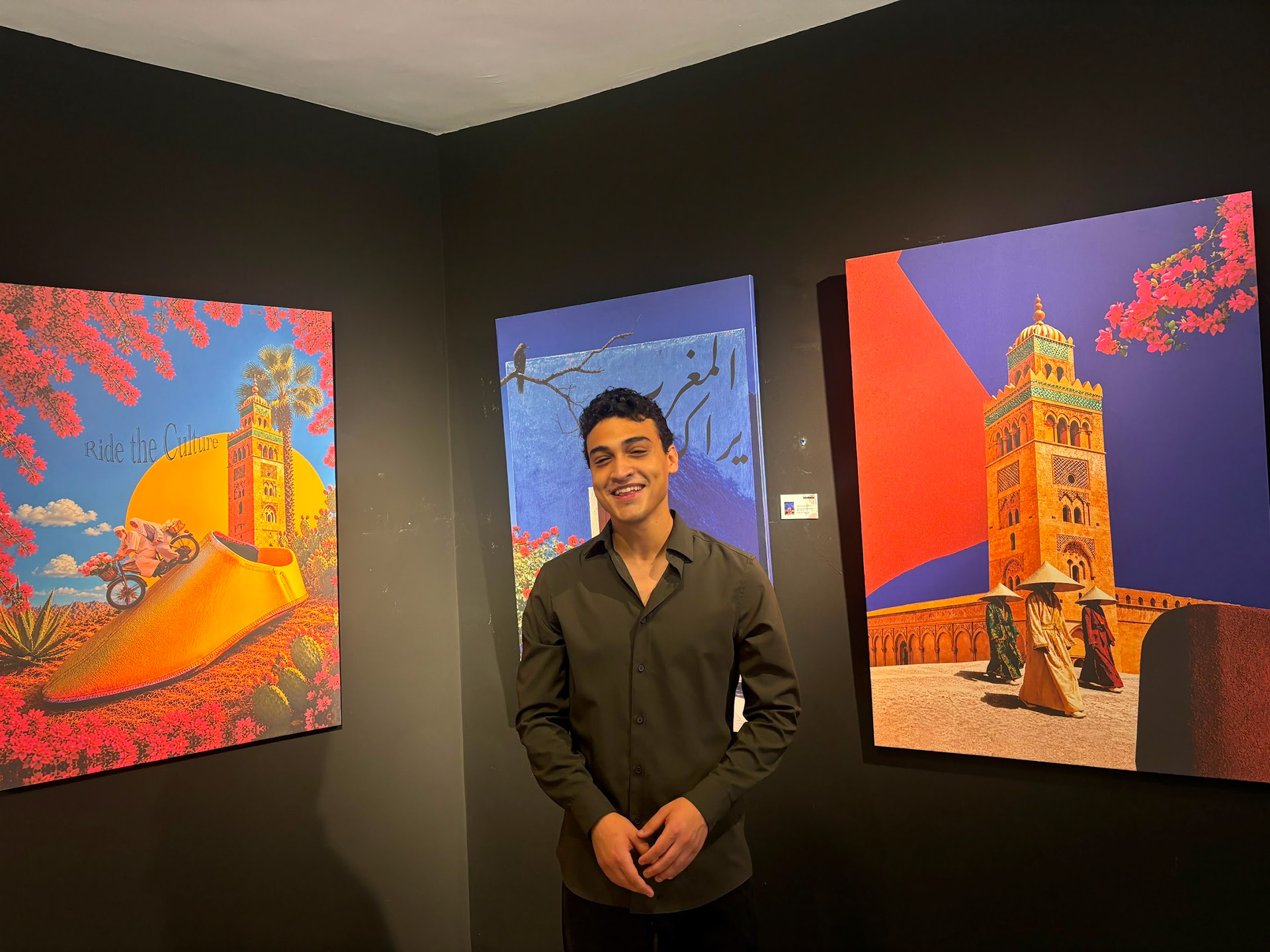
After spending several years studying and living in Montreal, he found himself looking more closely at the culture he had left behind. Returning to Morocco made previously ordinary details newly visible: architecture, colours, objects, gestures, old photographs, music, clothing and everyday street scenes.
Marock Art gradually became the visual language through which he could reinterpret those observations.
Rather than reproducing Morocco literally or nostalgically, Idrissi began taking elements that already carried history and emotion and moving them into contemporary, sometimes surreal environments that remained immediately connected to their Moroccan origins.
After spending several years studying and living in Montreal, he found himself looking more closely at the culture he had left behind. Returning to Morocco made previously ordinary details newly visible: architecture, colours, objects, gestures, old photographs, music, clothing and everyday street scenes.
Marock Art gradually became the visual language through which he could reinterpret those observations.
Rather than reproducing Morocco literally or nostalgically, Idrissi began taking elements that already carried history and emotion and moving them into contemporary, sometimes surreal environments that remained immediately connected to their Moroccan origins.
Finding meaning behind familiarity
The starting point for a piece is often an immediate emotional response.
Idrissi is particularly interested in what exists behind familiar objects. An oud, traditional garment, taxi, building or archival photograph can carry considerably more than its literal function. It might contain memories, evoke a historical period, represent a particular city or trigger an emotion.
One question becomes central to deciding whether a reference has creative potential: can he transform it without making it lose its identity?
If an object remains familiar even after being placed somewhere unexpected, Idrissi knows there is something worth exploring.
Idrissi is particularly interested in what exists behind familiar objects. An oud, traditional garment, taxi, building or archival photograph can carry considerably more than its literal function. It might contain memories, evoke a historical period, represent a particular city or trigger an emotion.
One question becomes central to deciding whether a reference has creative potential: can he transform it without making it lose its identity?
If an object remains familiar even after being placed somewhere unexpected, Idrissi knows there is something worth exploring.
Researching beyond decoration
Research begins intuitively and becomes increasingly precise as a work develops.
Idrissi collects photographs, archives, architectural details, traditional objects, colour references and imagery from different periods of Moroccan culture.
But identifying an interesting image is only the beginning. He tries to understand the symbolism behind the elements he uses, where they originated, what they represented historically and what they might mean today.
Personal memory operates alongside this research. A childhood recollection, family memory, journey through Morocco or particular atmosphere can become as important as an archival reference.
The finished composition becomes a meeting point between these layers: collective memory, historical context and Idrissi's personal interpretation.
Idrissi collects photographs, archives, architectural details, traditional objects, colour references and imagery from different periods of Moroccan culture.
But identifying an interesting image is only the beginning. He tries to understand the symbolism behind the elements he uses, where they originated, what they represented historically and what they might mean today.
Personal memory operates alongside this research. A childhood recollection, family memory, journey through Morocco or particular atmosphere can become as important as an archival reference.
The finished composition becomes a meeting point between these layers: collective memory, historical context and Idrissi's personal interpretation.
Making the unexpected feel natural
Removing an object from its expected context does not automatically make a successful composition.
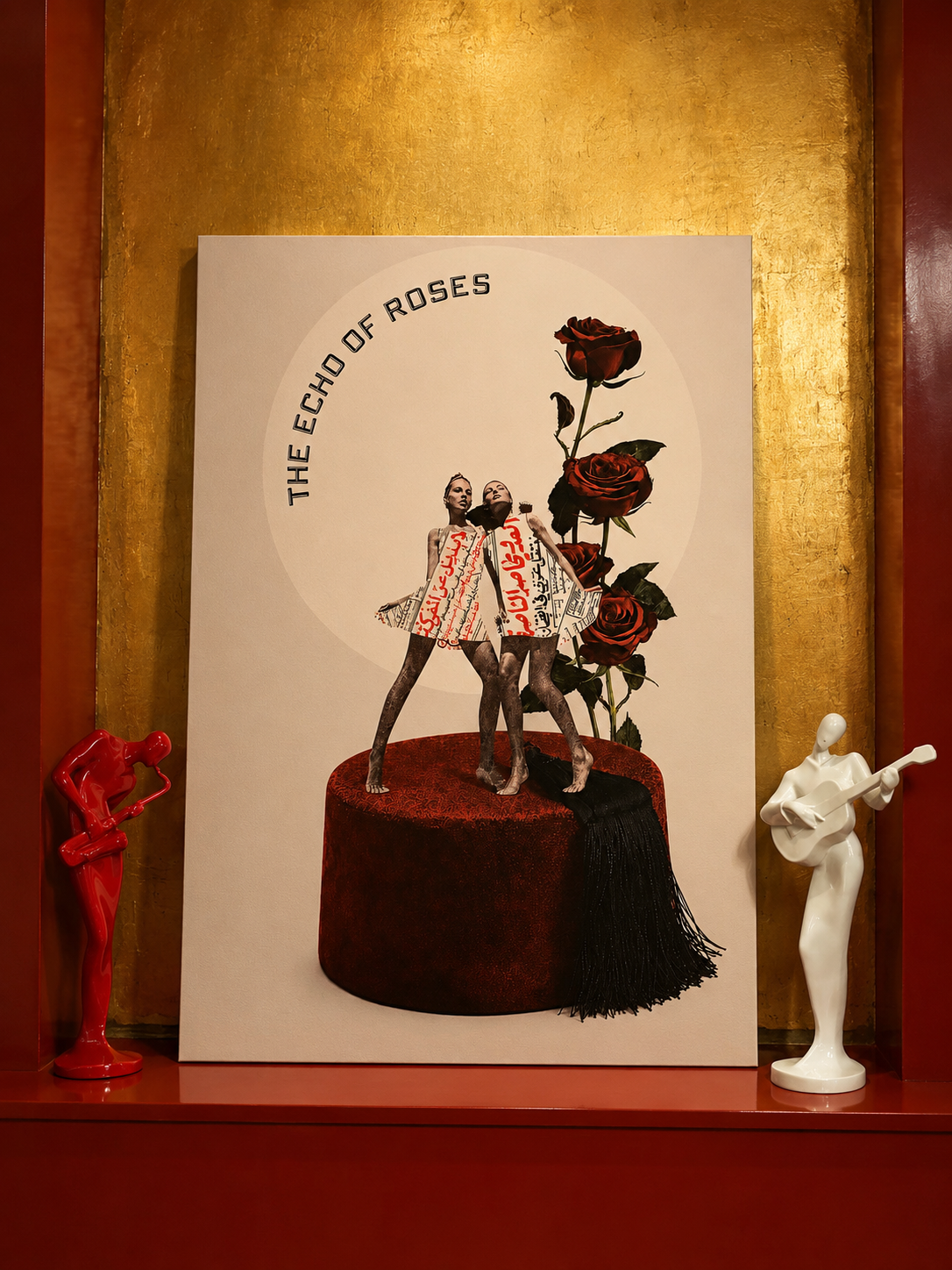
For Idrissi, an unexpected pairing has to produce new meaning rather than exist purely for visual surprise.
Elements that would ordinarily never occupy the same environment can be connected through colour, emotion, symbolism, rhythm or the wider story behind the piece.
Experimentation is therefore central to the process. Some combinations might appear visually beautiful but ultimately feel empty. Those are removed.
The compositions that survive are often those that initially feel unexpected, yet somehow natural once encountered.
That balance allows surrealism to generate curiosity without separating the imagery from its Moroccan identity.
For Idrissi, an unexpected pairing has to produce new meaning rather than exist purely for visual surprise.
Elements that would ordinarily never occupy the same environment can be connected through colour, emotion, symbolism, rhythm or the wider story behind the piece.
Experimentation is therefore central to the process. Some combinations might appear visually beautiful but ultimately feel empty. Those are removed.
The compositions that survive are often those that initially feel unexpected, yet somehow natural once encountered.
That balance allows surrealism to generate curiosity without separating the imagery from its Moroccan identity.
Colour as a visual language
Colour operates almost as a language of its own within Marock Art.
Idrissi frequently works with colours carrying strong associations with Morocco, including Majorelle blue, terracotta, saffron, turquoise, deep red, earthy beige and green. But these colours do not necessarily remain within their traditional contexts.
Instead, palettes are built according to the emotional needs of each work.
Majorelle blue can simultaneously communicate nostalgia and contemporaneity. Terracotta can introduce warmth and earthiness. Deep reds can intensify a composition, while softer tones can create greater intimacy.
Colour also allows Idrissi to connect different periods. An archival reference can suddenly feel current simply through the visual environment in which it is placed.
It therefore becomes one of his primary tools for challenging the perception of heritage as something fixed in the past.
Idrissi frequently works with colours carrying strong associations with Morocco, including Majorelle blue, terracotta, saffron, turquoise, deep red, earthy beige and green. But these colours do not necessarily remain within their traditional contexts.
Instead, palettes are built according to the emotional needs of each work.
Majorelle blue can simultaneously communicate nostalgia and contemporaneity. Terracotta can introduce warmth and earthiness. Deep reds can intensify a composition, while softer tones can create greater intimacy.
Colour also allows Idrissi to connect different periods. An archival reference can suddenly feel current simply through the visual environment in which it is placed.
It therefore becomes one of his primary tools for challenging the perception of heritage as something fixed in the past.
From screen to space
The experience of a Marock Art composition changes considerably once it leaves the screen.
Digitally, the composition itself tends to be encountered first. At large physical scale, texture, presence and previously overlooked details begin to take on greater importance.
The environment also enters the work.
Architecture, furniture, lighting and even the viewer's distance from the piece can influence how it is experienced. A digital image consequently becomes an object with a physical relationship to the space surrounding it.
For Idrissi, this transition is fundamental. He does not imagine Marock Art pieces as images intended to exist exclusively online. He wants them to occupy space and become objects people can live with.
Heritage as something alive
Ultimately, Idrissi wants his work to challenge the idea that heritage belongs exclusively to the past.
For Moroccan audiences, he hopes an image can trigger recognition, perhaps through an object, place, memory or even a feeling that is immediately familiar but difficult to articulate.
For viewers without the same cultural references, the objective is different. The imagery can instead become an invitation to curiosity and to discovering the histories and meanings behind what they are seeing.
Both experiences return to the same intention.
Idrissi wants the work to feel familiar and new at once, presenting Moroccan identity not as something static or folkloric, but as a living culture capable of evolving, being questioned and continuously reimagined.
The experience of a Marock Art composition changes considerably once it leaves the screen.
Digitally, the composition itself tends to be encountered first. At large physical scale, texture, presence and previously overlooked details begin to take on greater importance.
The environment also enters the work.
Architecture, furniture, lighting and even the viewer's distance from the piece can influence how it is experienced. A digital image consequently becomes an object with a physical relationship to the space surrounding it.
For Idrissi, this transition is fundamental. He does not imagine Marock Art pieces as images intended to exist exclusively online. He wants them to occupy space and become objects people can live with.
Heritage as something alive
Ultimately, Idrissi wants his work to challenge the idea that heritage belongs exclusively to the past.
For Moroccan audiences, he hopes an image can trigger recognition, perhaps through an object, place, memory or even a feeling that is immediately familiar but difficult to articulate.
For viewers without the same cultural references, the objective is different. The imagery can instead become an invitation to curiosity and to discovering the histories and meanings behind what they are seeing.
Both experiences return to the same intention.
Idrissi wants the work to feel familiar and new at once, presenting Moroccan identity not as something static or folkloric, but as a living culture capable of evolving, being questioned and continuously reimagined.
Photos Mehdi Idrissi