

ZOOM IN WITH INÈS BOUALLOU
A photographer exploring emotion and vulnerability through self-portraiture
For Inès Bouallou, the self-portrait is not simply a way of representing herself. It can become a space for discovering emotions she has not yet named, confronting different versions of herself, or translating internal experiences through the body.
The self-taught artist from Salé works across photography and poetry, with a practice centred on self-portraiture, the body, gender, mental health, emotion and vulnerability. Writing, which she describes as her first love, regularly enters this practice through texts accompanying photographic series and collaborative projects that combine images with reimagined interviews.
In this Zoom In, Bouallou takes us inside the making of her self-portraits, from improvising in front of a white wall to constructing gestures and domestic scenes, multiplying herself within a frame, navigating the discomfort of photographing in public, and questioning when a recognisable style risks becoming repetition.
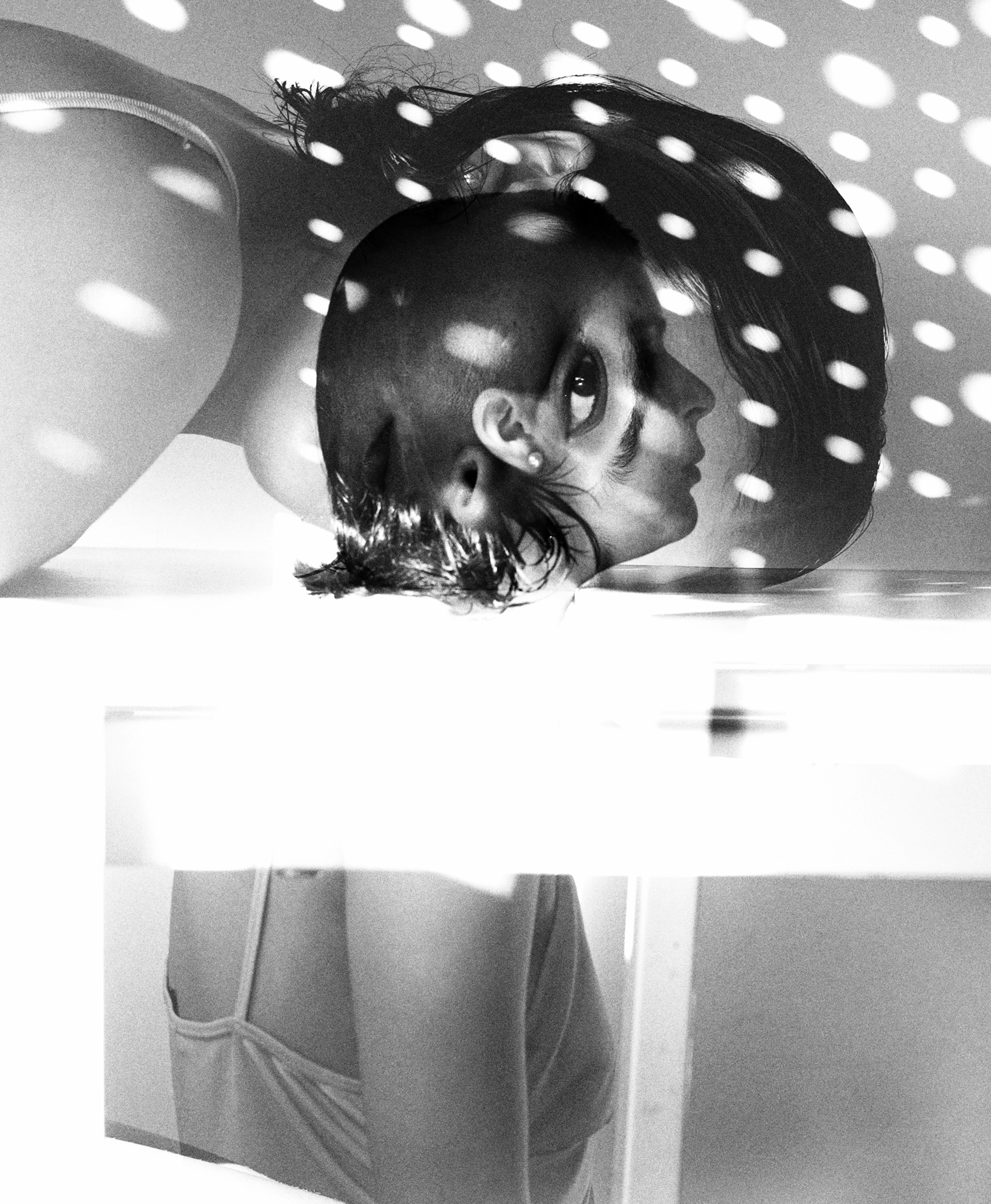
When photography becomes a way of finding the emotion
Bouallou does not necessarily begin an image with a clearly identified emotion. At times, she does not yet understand what she is feeling when the photographic process begins.
Photography can instead become a source of comfort and a space for exploration. The making of the image becomes a journey through emotions that initially remain abstract.
At other moments, the starting point is more identifiable: sadness, weariness, frustration or nostalgia. Bouallou explores these states through her body, particularly movements of the hands and head, as well as through objects introduced into the image. Through that physical process, emotions that began internally can gradually rise to the surface and take visual form.
Between an image in mind and improvisation
There is no single starting point for a Bouallou self-portrait.
Sometimes an image already exists in her imagination and the process is about bringing it into physical and photographic form. At other times, she begins without a predetermined outcome and allows improvisation to guide the image.
Manipulation also becomes part of that experimentation. Double exposures and double self-portraits allow her to play with the image and introduce possibilities that may not have existed at the beginning of the process.
The self-portrait can therefore move between construction and discovery, with the final image emerging through both intention and experimentation.
Bringing multiple selves into the same space
Bouallou approaches her body as a field for emotional exploration and introspection.
Rather than treating the self as a single, stable presence, her images can bring together a multitude of internal voices: the saboteur, the comforting friend, the critical self, the imposter and the ego that wants to show itself.
Through multiplied bodies and contrasting behaviours, these different selves can occupy the same visual space and enter into dialogue with one another.
Yet conflict is not the only relationship she explores. Her self-portraits can also become spaces for tenderness and self-love, reflecting the contradiction of knowing that one should not become one's own enemy while recognising how easily that can happen.
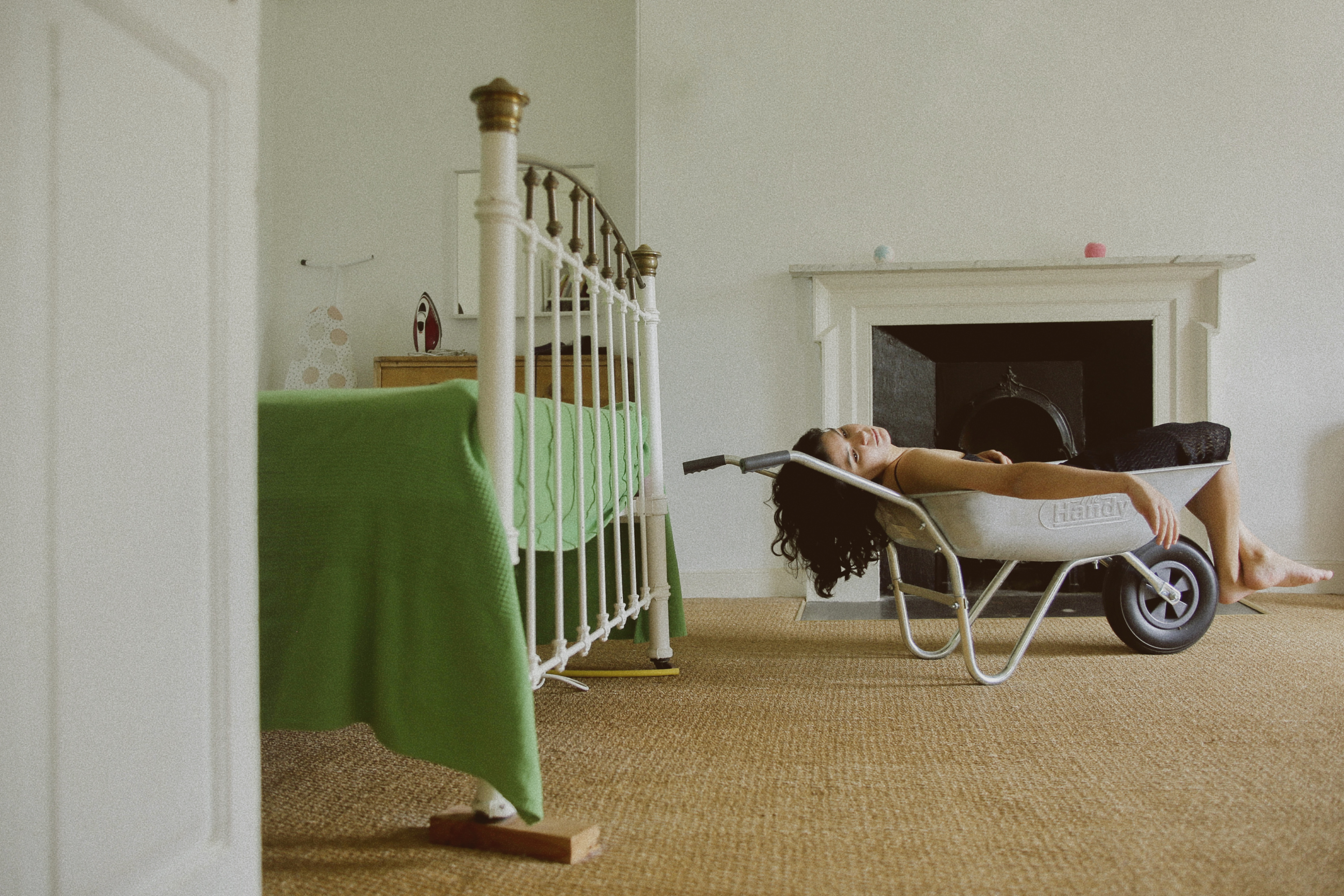
Vulnerability without defining it
Vulnerability is central to how Bouallou's work can be perceived, but she does not approach an image by determining precisely what should or should not appear vulnerable.
For her, vulnerability is subjective. An image that appears deeply vulnerable to one viewer may not carry the same meaning for another.
Rather than trying to impose a particular response, she is interested in the feeling produced through the encounter with an image. Often, she is not looking for a predetermined reaction at all.
That absence of a fixed intention can become part of what gives the resulting photograph its sensitivity.
Constructing intimacy at home
Many of Bouallou's self-portraits are created in her living room or bedroom. Because these spaces are already intimate to her, they give her greater freedom to explore expression, movement and pose.
The construction of an image can be highly deliberate. She may decide on a particular movement or gesture, rearrange tables and chairs, and determine exactly where her body should occupy the composition.
But the opposite can happen too. A white wall can be enough for her to begin improvising and allow the editing process to transform what she has photographed.
Technically, the process can be direct. Bouallou positions herself in front of a tripod, photographs in 10-second bursts, returns to inspect the results and can begin editing only minutes later.
This constant movement between photographer, subject and editor makes the self-portrait an unusually immediate feedback loop. She constructs the image while simultaneously observing and responding to herself within it.
Leaving the controlled space
Taking the same process outside changes its possibilities.
In public space, Bouallou can feel unsettled and stressed. The freedom she experiences at home to explore her body and its movements becomes more restricted when other people, potential harassment and concern for her camera enter the process.
That discomfort is informed by experience, including an incident in which she was harassed while photographing outdoors.
Not every space outside the home produces the same relationship, however. More residential environments can retain a degree of privacy. While creating her recent series The Unbearable Lightness of Being, Bouallou found working in such spaces more comfortable precisely because they existed somewhere between public exposure and private intimacy.
Between developing a style and repeating it
Bouallou's current experimentation is also shaped by a question familiar to many artists who develop a recognisable visual language: when does consistency become repetition?
Periods of high productivity do not necessarily leave her satisfied. The expectation she places on herself to produce work that feels creatively strong can lead to creative blocks, particularly when she recognises her established style but questions whether she is moving beyond it.
For Bouallou, the line between style and repetition can be extremely fine.
Taking breaks and looking for different sources of inspiration has become one response to that tension. Yet she also acknowledges that the outcome of a creative process cannot always be controlled.
Earlier works can retain an emotional force that is difficult to deliberately reproduce. She points to the 2021 series La vie est ailleurs as one of her most moving bodies of work, while The Unbearable Lightness of Being, created in June 2026, represents a more recent point in that continuing exploration.
Rather than resolving the tension between a recognisable language and the desire to evolve, Bouallou's practice continues to work within it, using the self as both subject and space for experimentation.
Photos Inès Bouallou
Photos Inès Bouallou