

IN CONVERSATION WITH HAFIDA ZIZI
On memory, freedom, and carrying Amazigh women's stories through ar
For Hafida Zizi, art began long before she considered herself an artist.
It was present in the wool her mother dyed, the carpets she wove, the colours she combined and the symbols she placed within them. It was present in the women Zizi observed around her growing up, in their work, their gestures and their quiet strength.
Her own path towards painting would come later. Married at 15 and unable to complete her studies, she began painting seriously at 28. What emerged was not only an artistic practice, but another way of learning, remembering and understanding herself.
In this conversation with CULTIQ, Zizi reflects on what her mother passed down to her, the freedom she found through art, the women who continue to inhabit her paintings, and her desire to preserve pieces of Amazigh and Moroccan memory that might otherwise disappear.
Learning to see through her mother
When Zizi remembers her mother weaving carpets and dyeing wool, colour is only part of what comes back.
Her mother offered her another way of seeing ordinary life, transforming wool, thread, colour and patterns into things capable of carrying meaning.
"Every colour carried a feeling, and every symbol could carry a story."
Zizi did not necessarily understand that as a child. Looking back, however, she recognises how deeply those details entered her own artistic language.
Her mother also passed down patience, precision and the pleasure of working by hand. More fundamentally, she showed her that art does not need to emerge from somewhere distant or exceptional.
"My mother taught me that art can be born from everyday life, from the things we live with and see without always noticing their value."
Giving herself permission to choose
Zizi did not suddenly decide at 28 that she was an artist.
The courage came gradually, through the accumulation of experiences and emotions that had already shaped her life. By the time she began painting seriously, she understood herself differently.
Painting created a space in which the roles imposed by life could temporarily disappear.
"Painting became a space where I could simply be myself."
At first, she did not name what she was doing as art or herself as an artist. She painted because she felt a powerful need to paint.
Over time, that need revealed itself as something larger than a hobby. Painting became a language for expressing herself, her memories and the women she had known.
"Perhaps art did not only give me courage. For the first time, it gave me permission to choose myself."
When life became the school
Marriage at 15 pushed Zizi into adulthood at an age when, as she describes it, she should still have been studying and discovering herself.
Her formal education stopped and another kind of life began.
She does not describe that period solely through what was lost. It also became part of what shaped her.
"Life became my school."
People, responsibility, pain, happiness and mistakes all became forms of learning.
When art later entered her life, she felt she was recovering something that had remained unfinished. Painting became more than learning a skill.
"I wasn't only learning how to paint. I was learning myself again."
Art offered another kind of independence, the possibility of choosing her colours, subjects and the experiences she placed onto the canvas.
Although she could not finish her education at school, Zizi never stopped learning. Art eventually became one of the most important schools of her life.
Carrying many women inside one face
Before any other woman, Zizi carries her mother into her work.
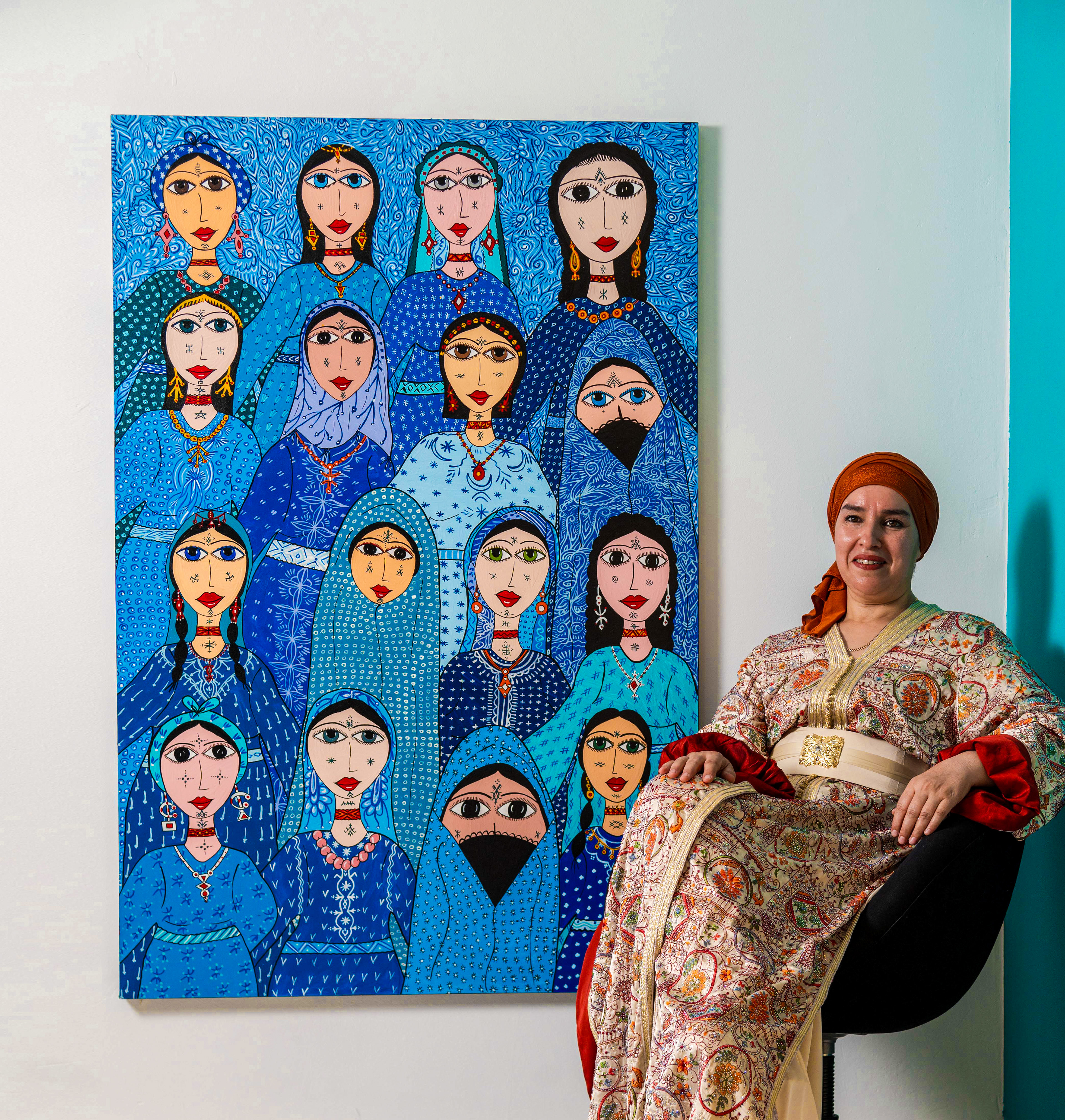
But the paintings are also inhabited by the women she remembers from childhood: village women, mothers and grandmothers, women working with their hands, weaving and cooking, raising children and confronting daily life with what she describes as silence and strength.
Her paintings do not only represent the Amazigh women she encounters in the present. They also return to the women preserved within her own memory.
"Sometimes the face I paint belongs to one woman, but inside it are the faces of many women."
For Zizi, their lives deserve to be understood beyond heritage alone.
She wants them to be seen as women with dreams, fatigue, strength, love and memory, people whose individual stories deserve to be told rather than simply represented as cultural symbols.
When colour says what words cannot
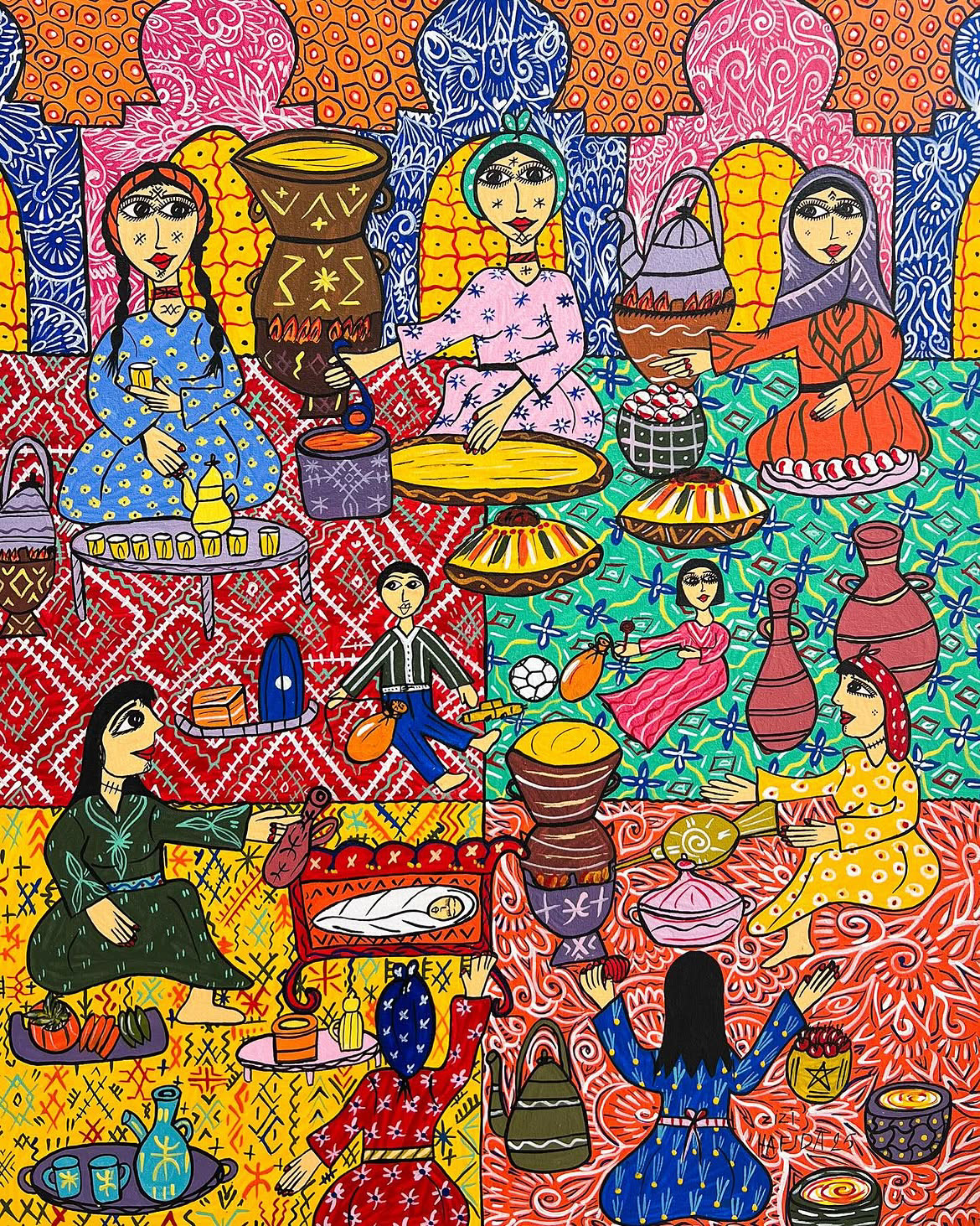
Colour, in Zizi's work, is not simply decorative.
It is emotion and memory.
She is drawn to strong colours because they resemble the complexity of the life she has known. Joy can coexist with sadness, strength with weakness, and loss with hope.
"Life is not one colour."
That complexity allows bright colour to carry unexpected emotional weight.
"Sometimes I cannot say something with words, but I can say it through colour. A colour can carry sadness without being dark, and a vivid colour can hide a deep story behind it."
Her ambition is therefore not to reproduce life visually, but to transmit something of how life feels.
When someone experiences an emotion in front of one of her paintings without immediately understanding why, Zizi feels that the painting has communicated what she wanted it to say.
Beginning before circumstances become perfect
Zizi understands what it means for a woman to feel that her dreams have been postponed or that circumstances have become stronger than her own desires.
Being considered an inspiration by other women is therefore something she experiences as both an honour and a responsibility.
Her advice begins with rejecting the idea of waiting.
"Don't wait for circumstances to become perfect before you begin."
Instead, she encourages women to start with what they have, what they already know and whatever small space they can create for themselves.
Her own journey is part of that message. She began painting at 28 without an art school or formal academic training.
She had something simpler: desire and the need to express herself.
For Zizi, discovery does not belong to a particular age. The essential thing is allowing oneself the opportunity to begin.
Looking at the past differently
Art did not make Zizi forget her past.
Instead, it changed the position from which she could look at it.
Some experiences cannot be changed, and some of the choices that shaped her life were not entirely hers to make. Painting allowed her to transform parts of those experiences into something new.
What once caused pain could become a subject for reflection, or take another form entirely as a colour, a face or a symbol.
"Art did not erase the past, but it helped me make peace with it."
Perhaps more importantly, art changed the way she understood herself in relation to that past.
"I no longer see myself only through the things that happened to me, but also through the things I was able to create for myself."
Leaving a trace of Amazigh women's lives
When Zizi imagines future generations encountering her paintings, she hopes they will look beyond colour and beautiful faces.
She wants the work to carry the memory of women who lived, worked, dreamed, raised children and maintained cultural knowledge through enormous social change.
"The Amazigh woman is not simply a symbol of heritage. She is an essential part of Moroccan memory."
Through her paintings, Zizi tries to preserve details she fears may gradually disappear: clothing, jewellery, tattoos, customs, celebrations, everyday routines and even women's expressions and ways of looking.
She knows a painting cannot preserve everything.
But preservation, for her, can also mean leaving enough behind for someone in another time to feel close to a life they never experienced.
"I want to leave behind a trace that tells future generations: these women were here, this was how they lived, and this was our memory."
If someone decades from now encounters one of her paintings and feels they understand a little more about an Amazigh woman they never knew, or a part of Morocco they never lived, Zizi will consider that her art has fulfilled its purpose.
Photos : Hafida Zizi